
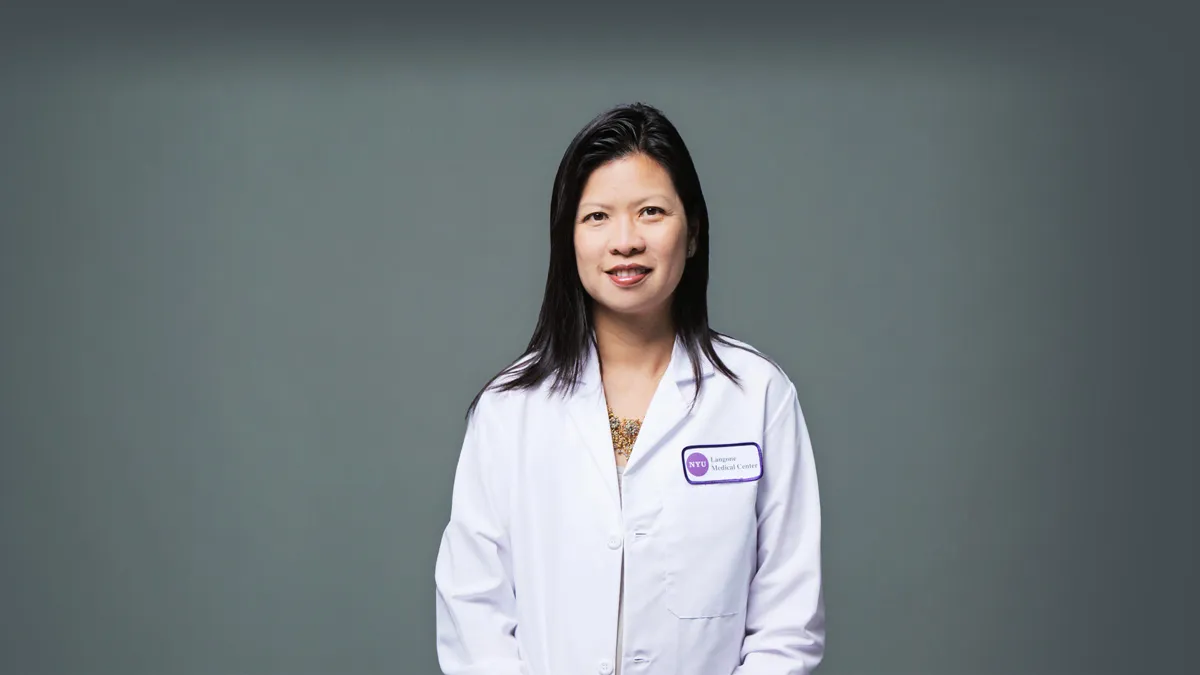
Linda Moy, MD—professor and vice chair for artificial intelligence in the department of radiology at NYU Grossman School of Medicine, clinician-scientist with the Center for Biomedical Imaging and the Center for Advanced Imaging Innovation and Research at NYU Langone Health—has become the 2026–2027 vice president–elect of the International Society for Magnetic Resonance in Medicine (ISMRM). The society is the world’s largest professional community dedicated to the advancement of MRI technologies and applications in medicine. Dr. Moy was elected to the post in March and assumed the role in May, after the society’s 2026 annual meeting held in Cape Town, South Africa.
“I was privileged to have been nominated for this leadership role by the committee and the board of trustees,” said Dr. Moy in a recent interview. Nominated candidates were up for election among the society’s more than 8,000 members. “It’s a real honor that they picked me.”
The win puts Dr. Moy on a four-year track to serve consecutive one-year terms as ISMRM’s vice president–elect, vice president, president, and past president.
“This is the largest MRI organization in the world,” Dr. Moy said, adding that the ISMRM brings together a constellation of stakeholders. Beyond radiologists, the society includes MR technologists, engineers, physicists, imaging device manufacturers and pharmaceutical vendors “to form a vibrant community where people are thinking about ways to use MRI to address some of the hard questions” about early detection and treatment of diseases.
Recognized as an international expert on breast MRI, Dr. Moy is also known as a leading voice on artificial intelligence in radiology. With colleagues at NYU Langone, where she is the radiology department’s inaugural vice chair for AI, she has investigated and codeveloped machine learning systems for breast cancer detection. And with researchers at other institutions, she has coauthored numerous reviews and opinions examining the advantages and risks of AI systems in medical imaging. She is editor emerita of Radiology, the flagship scientific journal of the Radiological Society of North America (RSNA), and member of the American College of Radiology Commission on Breast Imaging—a body dedicated to advocacy, education, and continuous refinement of breast imaging standards.
In 2006—before becoming known for breast imaging research, advancement of screening standards, and examination of AI’s potential in radiology—Dr. Moy was a junior physician whose interest in obtaining more information from dynamic contrast-enhanced MRI of the breast led her to undertake a research project and share the results at an ISMRM meeting—her first.
“I remember being really nervous as someone who was very famous approached my poster and said, ‘Can you tell me about your research please?’” recalled Dr. Moy. The connection “was the first step in what became a long-term mentorship,” an experience she said is emblematic of the society whose membership ranges from MRI’s most accomplished veterans to junior trainees taking their first steps in the field.
As ISMRM’s vice president–elect and in the subsequent posts, Dr. Moy will work with colleagues on the executive committee, the board of trustees, the numerous area committees, and with the membership at large to steward and strengthen the society. One of the major undertakings the ISMRM faces in the coming years is the formulation of a strategic vision and plan for the decade starting in 2028.
As the populations in the developed world age and those in the developing world increase, Dr. Moy said that the need for better, faster, more informative, and more accessible imaging will continue to grow, and that she sees the ISMRM as an indispensable forum for helping radiology meet these demands. “I’m really excited for what will happen for our field in the next five to ten years,” she said.
Related Stories
Linda Moy, radiologist and researcher whose work spans breast imaging and artificial intelligence, talks about patient-centric radiology, AI systems in clinical practice, and the field's rising environmental awareness.

The fastMRI dataset now includes curated breast MRI data to boost AI innovation in radial, dynamic contrast-enhanced, ultrafast MRI of the breast.
Recent research shows that sodium MRI can predict cancer response to chemotherapy. The National Cancer Institute is funding NYU Grossman School of Medicine to develop and validate the method.
NYU Langone researchers won a deep learning challenge to detect lesions in digital breast tomosynthesis (DBT) images. We discuss the obstacles that DBT poses to deep learning and look at how our team navigated them.