
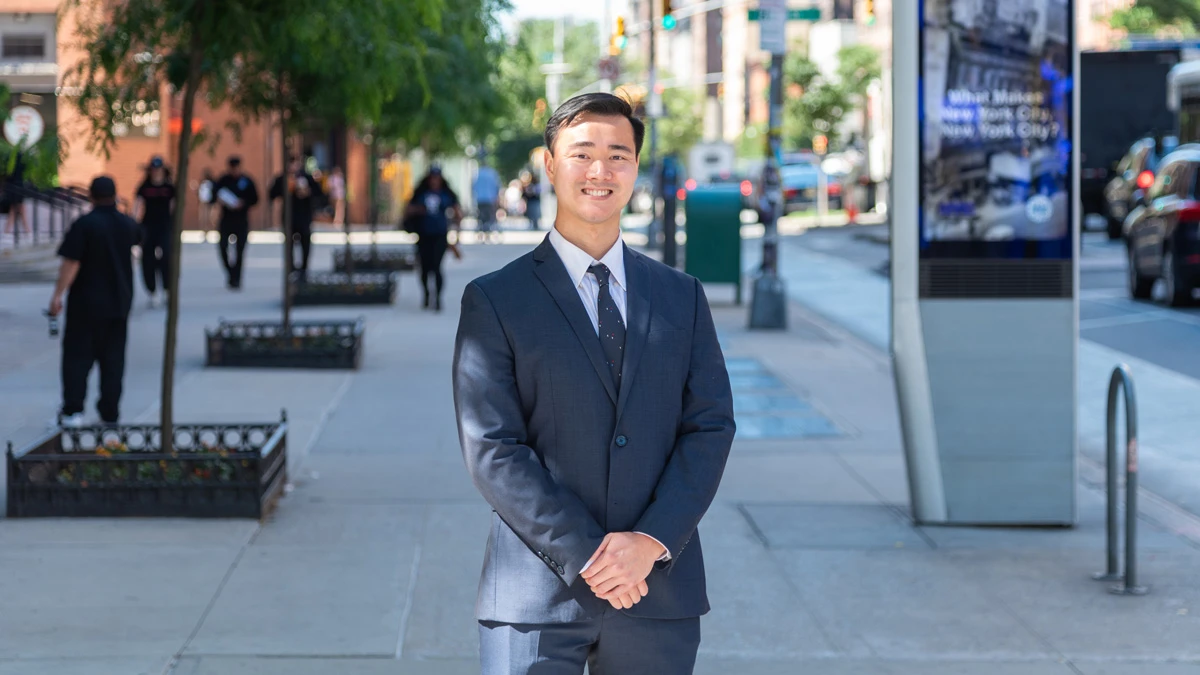
Peter Hsu has successfully defended his PhD thesis in biomedical imaging and technology at NYU Grossman School of Medicine. The defense was held on Monday, June 8, at NYU Langone Health.
In the course of his PhD training, Dr. Hsu has led the development of a new framework for performing quantitative volumetric brain analysis with ultra-low-field MRI. The work was advised by Patricia Johnson, PhD, and Jelle Veraart, ScD, assistant professors of radiology and scientists with the Center for Biomedical Imaging and the Center for Advanced Imaging Innovation and Research at NYU Langone.
Dr. Hsu’s dissertation, titled “Advancing the Accessibility of Neuroimaging Biomarkers with AI-Driven Ultra-Low-Field MRI,” explores the research potential of Hyperfine Swoop, a 0.064-tesla head-only MRI scanner and the only ultra-low-field system with FDA clearance for neuroimaging.
Operating at a magnetic field of less than 0.1 tesla, ultra-low-field MRI scanners are approximately 95-percent weaker than the conventional medical scanners that range between 1.5 and 3 tesla, known as high field. Ultra-low-field MRI machines are smaller and lighter—they can be wheeled between rooms or transported in the back of a van.
The portability and affordability of this new class of MRI scanners have raised hopes that the technology may help address disparities in access to medical imaging, which also affect research. At present, research data overrepresent populations from urban centers in developed countries—places that have by far the most MRI machines. This imbalance may obscure valuable information from scientists, skew findings, or render research less generalizable to underrepresented populations.
For all its agility, ultra-low-field MRI has several limitations, including lower image resolution and lower image quality than those delivered by conventional clinical MRI machines. Meanwhile, scarcity of ultra-low-field MRI data hinders the training of AI algorithms that could improve the quality of images and aid in their analysis, both medical and scientific.
Dr. Hsu’s doctoral research explores what is possible within these constraints and proposes a framework for obtaining research-grade volumetric brain data on the Swoop system.
Volumetric brain analysis—estimation of the size of grey matter, white matter, and select subcortical structures—is an established method of evaluating features linked to aspects of neural development, brain aging, psychiatric disorders, and neurodegenerative conditions. The big questions answered by Dr. Hsu’s thesis are whether the Hyperfine Swoop system can be used to gather data sufficiently accurate for scientific inquiry (yes), and how (read on).
In his dissertation, Dr. Hsu proposes a framework that combines an acquisition scheme called TomoBrain with a deep learning postprocessing tool called CycleGAN. The former produces optimal data for volumetry and the latter increases the resolution of obtained images in order to further improve biomarker analysis.
TomoBrain refers to a particular arrangement of scan directions and contrasts that, when combined, yield data suitable for brain volumetry. Assembling acquisitions from multiple directions in order to compose sharper images is an approach adapted from high-field MRI research. To arrive at TomoBrain—reported in 2025 in the journal Human Brain Mapping—Dr. Hsu and colleagues investigated various acquisition scenarios and analyzed the resulting images for volumetric consistency at ultra-low field, high field, and across both field strengths. The team found that the method delivered “high accuracy for large brain regions”—such as grey and white matter—“but low for small regions,” like the hippocampus, said Dr. Hsu at his defense.
Small anatomical features in the center of an imaged volume pose particular challenge at ultra-low field but can be important. The size of the hippocampus, for instance, is known to be an early marker of deficits in cognition and memory.
To overcome this limitation, Dr. Hsu and colleagues developed an artificial intelligence model that intakes TomoBrain images and boosts their resolution. The team found that TomoBrain data processed with the CycleGAN model, showed “sustained hippocampus improvements across an external validation dataset acquired on different scanners and at different sites,” writes Dr. Hsu in his thesis.
Next, Dr. Hsu and colleagues analyzed data processed with the CycleGAN model to understand which constituent scans in the original TomoBrain scheme contribute the most to the accuracy of the volumetric analysis and which contribute the least. They found that a streamlined TomoBrain strategy—which they call a cascaded model framework—“gets you similar quality with half as many images,” said Dr. Hsu, noting that the team has found “no significant differences after CycleGAN with the full TomoBrain input versus the optimized cascaded input.”
“Our work establishes a baseline for quantitative biomarker research at ultra-low field,” Dr. Hsu said.
He expressed the hope that efforts to advance the use of ultra-low-field MRI in population-level research continue—perhaps aided by the approach he and colleagues have proposed.
“Approximately 70 percent of the world population lacks access to MRI,” said Dr. Hsu. “MRI is expensive—the startup cost is approximately one million dollars per tesla.” Ultra-low-field MRI scanners “are getting popular because they address many of the shortcomings of high-field systems,” he said. For an ultra-low-field device, “the costs are significantly reduced.”
Related Publication
Morphological Brain Analysis Using Ultra Low-Field MRI.
Hum Brain Mapp. 025 Jul;46(10):e70232. doi: 10.1002/hbm.70232
Related Stories

NYU Langone study finds ultra-low-field MRI and deep learning image processing tools accurate for brain volumetry research, recommends "TomoBrain."

How a moonshot effort to build an open-source MRI scanner from scratch in less than a week played out, and what it means for imaging research at large.