
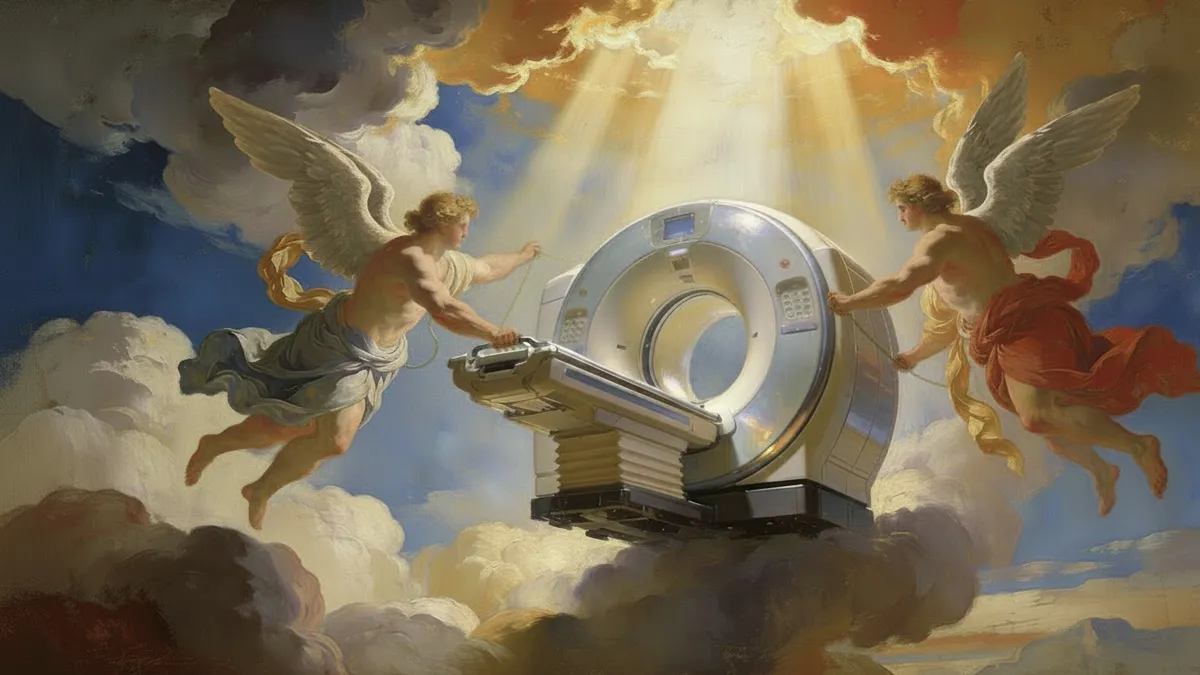
Long past business hours on the last night of July in a radiology clinic on the eastern edge of midtown Manhattan, Bernhard Gruber, PhD, postdoctoral fellow at NYU Langone Health and scientist with Center for Advanced Imaging Innovation and Research, was about to end something.
Around midnight, Dr. Gruber stood up from the console of an MRI scanner and reached toward a wall-mounted control panel. He lifted a plastic protective shield and brought his hand near a large red button engraved with the words “STOP STOP STOP.”
“Pressing the button is almost like ending a life,” said Dr. Gruber. “A life of a machine—that’s what it feels like.”
The machine in question was a Siemens 3-tesla MRI scanner at NYU Langone’s Center for Biomedical Imaging—a radiology clinic and MRI research facility. The MRI was being retired to make room for a Connectom.X, a cutting-edge scanner for brain research.
The outgoing scanner, installed in 2004, started out as a Magnetom Trio. A decade later, Siemens engineers stripped the components down to the magnet and outfitted it with new hardware and software, transforming the scanner into a Magnetom Prisma. But almost everyone who has worked with the machine during its 21-year tenure has known the Trio-cum-Prisma by its internal designation, “FMR9.” In a department that today operates more than 50 MRI machines, FMR9 was not just another unit.
“It was so central,” said Yvonne Lui, MD, professor and vice chair for research in the department of radiology at NYU Langone. Around the time of FMR9’s arrival, Dr. Lui was a trainee completing a residency in radiology and embarking on a fellowship in neuroradiology. Back then, the scanner combined high 3-tesla field strength with Siemens’s latest mutlichannel capability called “total imaging matrix” (Tim). When the trade publication AuntMinnie reported that “NYU Medical Center in New York City was the first facility to install the 3-tesla [Trio with Tim],” the scanner in question was FMR9.
FMR9 also marked another, more consequential first: the beginning of a collaborative partnership between NYU Langone and Siemens Healthineers, a major manufacturer of MRI scanners. The arrangement would bring high-end instrumentation to the health system and put industry engineers in close communication with imaging researchers. More than 20 years on, the alliance continues to grow and yield dividends in patient imaging, MRI science, and research innovations that reach the medical device market. To date, the partnership has helped disseminate technologies that include free-breathing dynamic contrast enhanced MRI and AI-accelerated image reconstruction.
Among the myriad factors that contribute to such advances, one prerequisite is to run lots and lots of MRI scans: scans of people, scans of ex-vivo samples, and scans of phantoms (models that simulate physiological properties); clinical diagnostic scans, research scans to advance scientific inquiry, technical development scans to test, troubleshoot, and optimize RF coil designs and RF pulse sequences; scans to experiment with image reconstruction algorithms; scans to compare new techniques against standard-of-care and state-of-the-art methods; scans to evaluate the quality and safety of new devices; scans with intravenous or inhalable contrast agents, scans with deliberate motion, functional scans during which patients may react to stimuli or perform assigned tasks; and “multinuclear” scans tuned to signal from elements other than hydrogen.
Whatever the medical and scientific questions, for 21 years FMR9 was up for tipping spins in search of answers day after day after day. According to internal data, from 2011 through mid 2025 the system logged nearly 70,000 imaging sessions—an average pace of about 100 sessions per week. Earlier data are not available, but at this rate the machine would have logged approximately 100,000 exams and experiments over its lifetime.
“It was so versatile,” said David Mossa, MRI manager who has been with NYU Langone since 2004. “You could throw anything at it and it could do it.”
By virtue of its research capacity, FMR9 attracted all manner of coil prototypes, unique phantoms, and science paraphernalia to the storage cabinets in its otherwise generic room. “You open a drawer, and you see these weird gadgets and weird things,” said Mossa. An exotic object could be a part of an investigation bound for a high-impact journal or a grad student’s homework. More than two dozen biomedical-imaging-and-technology PhDs minted at NYU Grossman School of Medicine learned the arcana of magnetic resonance imaging on the FMR9. (Several have gone on to head their own research groups.)
Live Long and Prosper
Remember 2004? Cell phones were for making calls, Google was rolling out a beta version of a new service called Gmail, and a fresh startup named TheFacebook was making waves on the web as an invitation-only spot for Ivy League undergrads.
As in tech, in radiology a couple of decades is a lifetime.
Dozens of scanners have since joined and left NYU Langone’s MRI stable: some reaching natural end of service, others making room for next-generation replacements, and an unfortunate few drowning in the floodwaters brought by Superstorm Sandy. But FMR9, whose tenure would eventually span nearly half the history of an imaging modality that’s now barely over 50, kept ticking.


“It was the workhorse,” said Dr. Lui, whose research studies had been conducted on the FMR9. “Central to clinical work, to translational work, to fundamental research, and it’s been chugging and chugging along with usefulness.”
Dr. Gruber, an expert in RF coil and gradient systems who ran the very last scan on the machine, attributed FMR9’s dependability to the vintage of its magnet. That magnet—the Trio heart inside the Prisma body—was engineered in an era before cost-optimization led manufacturers to make scanners lighter, easier to assemble, and less dependent on helium. “They were developed out of necessity to have the most homogenous volume possible in the magnet,” Dr. Gruber said of Trio-era machines, contrasting them with contemporary MRIs in which the uniformity of the magnetic field increasingly relies on a range of auxiliary shimming technologies.
On that last night in July, Dr. Gruber sat at the FMR9 console after hours and—as often happens in research—had a problem. He and colleagues have been developing a multinuclear coil for gauging breast cancer response to neoadjuvant chemotherapy. Just two weeks earlier, the coil had been coming along well, producing “gorgeous” data and giving “exceptional” performance. “But I thought I could push it a little further,” said Dr. Gruber. “And then it went over a cliff.”
Aware of FMR9s impending decommissioning, he had been burning the midnight oil trying to diagnose the issue. (Because troubleshooting on a different system would change multiple variables in the complex interplay of RF coil, MRI machine, and scanner software, potentially costing the team months of progress.) The search came down to the proverbial wire.
“I found the error around 10:30–11:00 p.m.” on FMR9’s final night, said Dr. Gruber. (The crux turned out to be coil component failure caused by overvoltage.) “You can’t believe [the relief],” he said. “These are the small victories.”
And because he was the last one in, it fell to him to push the big red button, initiating a release of liquid helium (a quench) and bringing FMR9’s magnetic heart to a stop.
Asked what that felt like, Dr. Gruber grew reflective. After 15 years of engineering MRI hardware, he has come to see each machine as distinct. “Every scanner in my opinion has a different sound,” he said, referring to the characteristic, rhythmical oom-pff of the cooling pump. The pump, also known as the cold head, condenses the helium that keeps the magnet superconducting at near absolute zero. Dr. Gruber, who is also a musician, finds the sound so soothing that he sometimes listens to recordings of it to relax. “It feels like home somehow.”
“Quenching the FMR9, it’s not hard,” he said, but it did bring up a lot of emotions: admiration, respect, a wave of relief at a solved problem, a twinge of lingering frustration at how the complexities of an MRI system can bedevil even experts, but also a hint of satisfaction in the deep command of such an intricate instrument. “It’s all opposing feelings,” he said.
Not least among them was a feeling shared by numerous colleagues whose research over the years had benefited from FMR9’s capabilities: gratitude.
Related Stories
NYU Langone welcomes an MRI research system for conducting in vivo investigations of the brain’s microenvironment with unprecedented sensitivity.

Recent research shows that sodium MRI can predict cancer response to chemotherapy. The National Cancer Institute is funding NYU Grossman School of Medicine to develop and validate the method.