
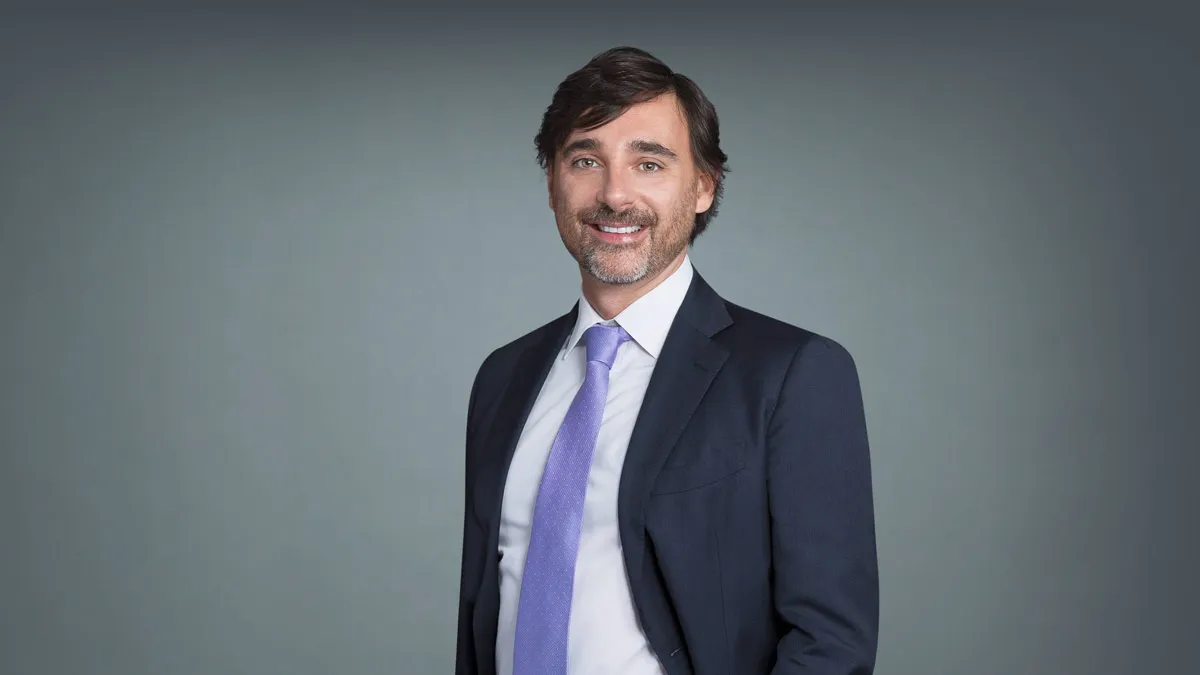
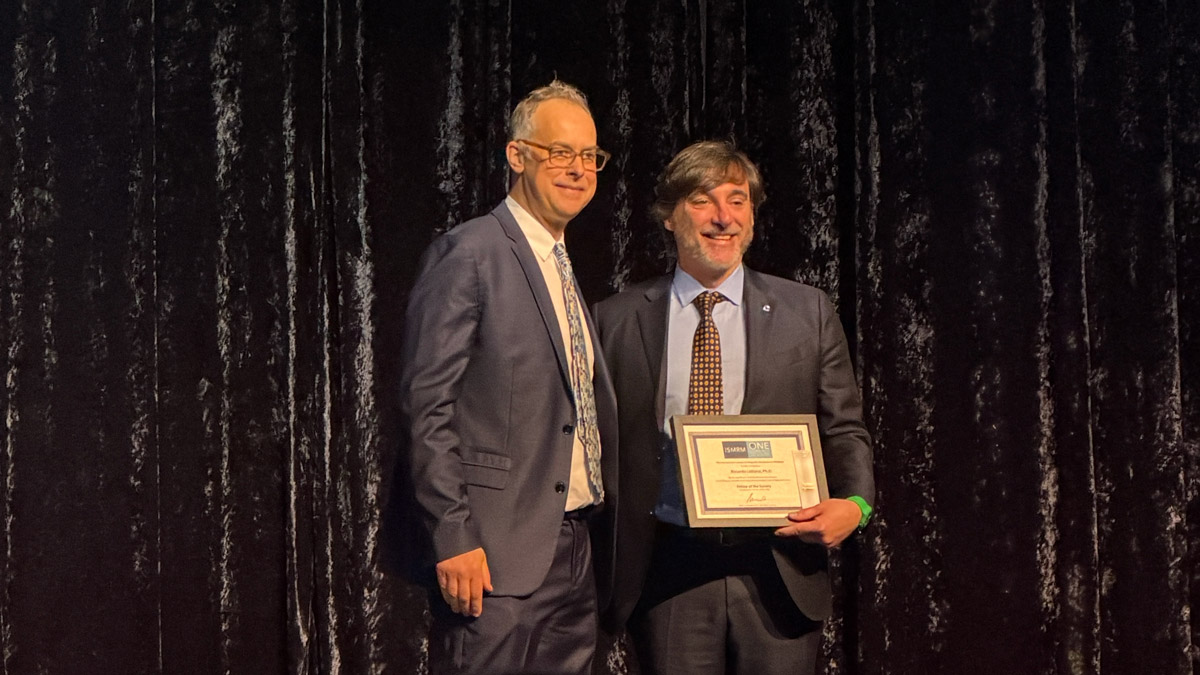
Riccardo Lattanzi, PhD, professor of radiology at NYU Grossman School of Medicine, director of the Bernard and Irene Schwartz Center for Biomedical Imaging at NYU Langone Health, and scientist with NYU Langone’s Center for Advanced Imaging Innovation and Research, has been named fellow of the International Society for Magnetic Resonance in Medicine (ISMRM)—the world’s largest professional community dedicated to the advancement of MRI technologies and applications in medicine. The honor was announced on Monday, May 11, at a weeklong annual meeting of the ISMRM held in Cape Town, South Africa.
The fellowship—also known as senior fellowship—recognizes those “who have contributed in a significant manner to the development of the society … to education in MR, and/or … to the field in its clinical or scientific development,” said Mark Griswold, PhD, ISMRM’s president, before congratulating this year’s honorees as they stepped onto the stage of the plenary hall at the Cape Town International Convention Centre.
“The ISMRM has been my scientific home since I was a graduate student,” wrote Dr. Lattanzi by email from South Africa. “Being recognized by this community carries a special weight and a sense of responsibility.”
In naming him among fellows, the society cited Dr. Lattanzi “for collaborative and innovative contributions to ultimate intrinsic SNR and SAR, MR electrodynamics, electrical property mapping, and multiparametric quantitative imaging.” These areas of inquiry explore how radiofrequency electromagnetic fields behave and how they interact with biological tissues; aims include reaching optimal MRI performance, obtaining new health information from MRI data, and transforming MRI scanners from qualitative imaging devices into quantitative measurement instruments.
The concepts of ultimate intrinsic signal-to-noise ratio (UISNR) and ultimate intrinsic specific absorption rate (UISAR), “serve as absolute benchmarks to assess coil performance and quantify how much room for improvement remains,” said Dr. Lattanzi, referring to devices that are used to excite spins in and receive signal from the body during an MRI exam. “The ideal current patterns associated with these limits provide insight into the design of coils that can approach ultimate performance.”
In this line of research, Dr. Lattanzi has worked since the early 2010s with colleagues at NYU Langone and elsewhere to formulate an analytic framework for optimal coil performance, use it to evaluate SNR performance of coil prototypes, explore ways of approximating ultimate intrinsic SNR with antenna architectures commonly used in coils, and model the ultimate intrinsic SNR in idealized geometries. In recent years, the investigations have led to the development of computational methods for estimating ideal current patterns in realistic models of human tissue and to the creation of software tools that iteratively optimize coil geometry in order to approach the theoretically highest SNR—a step toward automating what the team calls rational coil design.
Dr. Lattanzi has also pursued research into the use of MRI to measure electrical properties of biological tissue—an area that holds the promise of unlocking long-sought capabilities, new biomarkers, and quantitative data comparable across time, patients, and scanners. “Knowledge of these properties allows us to accurately predict how electromagnetic fields interact with biological tissue,” said Dr. Lattanzi, adding that potential benefits include “improving a number of technical aspects of MRI, such as RF safety, coil design, and parallel transmission; and therapeutic applications such as hyperthermia”—targeted heating of cancerous tissue. In 2025, he and colleagues proposed a machine learning approach to the reconstruction electrical properties from MRI data—one of the team’s many advances aimed at reducing the computational burden involved in tissue electrical property mapping.
Most MRI research aims attempt to answer one question: how to obtain more information in less time? One answer explored by Dr. Lattanzi and colleagues has been multiparametric quantitative imaging. A technique he and colleagues developed for evaluation of hip cartilage, based on an approach known as MR fingerprinting (MRF), “allows simultaneous estimation of multiple tissue and system parameters in a single acquisition within clinically feasible scan time, which is something conventional mapping techniques cannot achieve,” said Dr. Lattanzi. He has recently authored a book chapter on magnetic resonance fingerprinting in musculoskeletal imaging in a volume devoted to MRF for quantitative MRI. “This [imaging approach] opens the door to early detection of biochemical changes in cartilage, as well as characterization and staging of cartilage lesions, which could meaningfully improve diagnosis and monitoring of conditions like osteoarthritis,” he said.
Dr. Lattanzi’s investigations also include the development of end-to-end virtual MRI simulations and novel imaging approaches to quantification of wrist motion, detection of femoroacetabular impingement, and quantum computing for MRI. He is also professor of biomedical engineering and electrical and computer engineering at NYU Tandon School of Engineering.
“Science is never a solo endeavor,” Dr. Lattanzi said. The recognition “makes me reflect on the mentors who shaped me and the trainees and collaborators who pushed my thinking.”
Related Stories
Researchers at NYU Langone Health and scientists at Fermilab are exploring whether quantum computing can help bring about long envisioned quantitative MRI. Step one: teaching qubits (and qudits) to do the math.
MRI researchers at NYU Langone and colleagues propose a quantum approach to fixed-point arithmetic for ordinary differential equations.
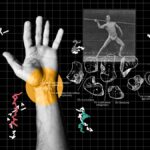
Imaging researchers at NYU Langone Health are getting close to quantifying the dynamics of natural wrist motion, which are not well understood.
Related Resources

A neural network for reconstructing electrical properties of materials and biological tissue from MRI data, plus synthetic phantoms.
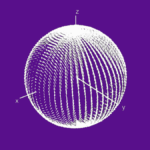
MATLAB code for determining the UISNR at the center of a dielectric sphere.