
Imaging scientists from the Bernard and Irene Schwartz Center for Biomedical Imaging at NYU Langone Health and colleagues from the Superconducting Quantum Materials and Systems Center (SQMS) at Fermilab have teamed up to investigate whether quantum computing can bring quantitative MRI closer to reality. The team has developed new methods for fixed-point and floating-point arithmetic to solve differential equations on quantum computers, and advanced through an NIH challenge that calls for innovative quantum computing applications in medicine.
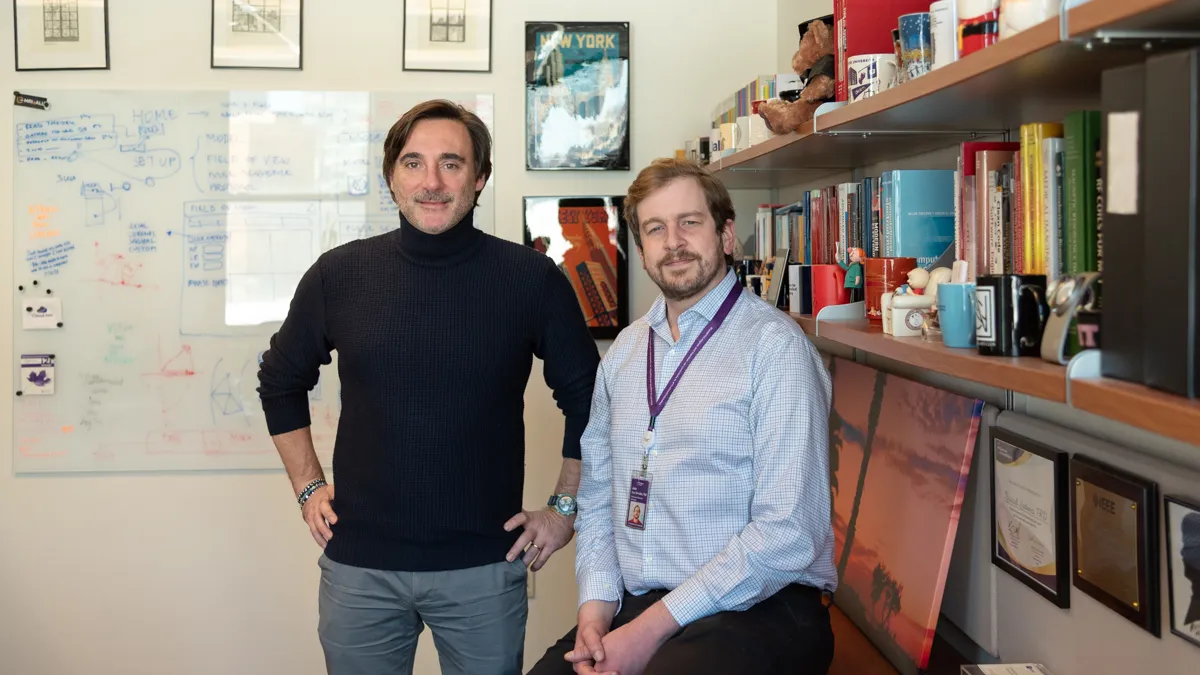
“We are the first trying to use quantum computing to improve quantitative MRI,” said Riccardo Lattanzi, PhD, professor of radiology at NYU Langone and director of the Center for Biomedical Imaging. The collaboration between NYU Langone and Fermilab started in 2022 after Dr. Lattanzi took up an invitation extended by Anna Grassellino, PhD, who heads Fermilab’s SQMS Center.
“The research question we’re trying to answer is whether we can use quantum parallelism to solve computationally intractable problems in MRI,” said José Cruz Serrallés, PhD, postdoctoral fellow at NYU Grossman School of Medicine who joined Dr. Lattanzi’s lab in order to pursue this inquiry. He has since led the development of two computational approaches to doing the math needed for MRI modeling on quantum devices.
In particular, the investigators are targeting magnetic resonance fingerprinting (MRF), a technique that emerged in the early 2010s. MRF relies on a simulated dictionary of “pseudorandom” signal evolutions (fingerprints) based on relevant physical properties. After a person is scanned with an MRF sequence designed to induce such signal evolutions in the body, the previously generated dictionary is searched for the closest match to the acquired data at each pixel of the image. The match assigns numerical values to the parameters of interest, such as T1, T2, and proton density—the ABCs of MRI contrast.
Quantitative MRI has long been envisioned as a more objective alternative to the current paradigm in which medical images are subject to qualitative evaluation and are not numerically comparable across acquisition types or MRI machines. By providing quantitative, tissue-specific information consistent across devices and time, qMRI has the potential to unlock deeper analysis, new biomarkers, and a new class of longitudinal studies.
Able to withstand significant undersampling and resistant to error, MRF has become a prime candidate for advancing quantitative MRI. However, despite fast acquisition, long or altogether computationally prohibitive reconstruction has kept MRF in the lab.
“If you want to use a really fine dictionary, it’s going to be hundreds of gigabytes,” said Dr. Cruz Serrallés. “And if you want to add another parameter, for example B0 inhomogeneity or magnetization transfer, the dictionary would just be way too large to use.”
Enter quantum computing.
Quantum bits can be put in a mode known as superposition, in which they exist simultaneously in multiple states, something classical bits cannot do. Theoretically, 100 qubits (quantum bits with two states) allow 2100 states, more than a nonillion (nonillion is a one followed by 30 zeroes). Quantum parallelism—a quantum computer’s ability to use quantum bits in superposition—can therefore hold a tremendous amount of information with relatively few qubits.
“And it’s a very nice way of holding all that information,” said Dr. Cruz Serrallés, because applying an operation to a qubit, modifies both that qubit and the state. Hence, “if you have a hundred qubits, you could apply a hundred operations to them, but you’re modifying 2100 states,” he explained. In that scenario, one could perform nonillions of operations without the computational cost of running so many computations directly. Things get even more interesting with quantum bits capable of more than two states, generally called qudits, where “d” denotes the number of states (as in, qudit with d=16).
In principle, such capacity means that an entire dictionary of fingerprints could be instantiated in a quantum superposition, without the need to build or store the entries on classical hardware. But most existing quantum algorithms are not written for systems as dynamic as an MRI experiment—an electromagnetic storm inside a scanner’s bore. In order to get to the envisioned quantum-enabled MRF, the researchers have to build the road, starting with the arithmetical methods needed to solve Bloch equations, which describe the physics of MRI.
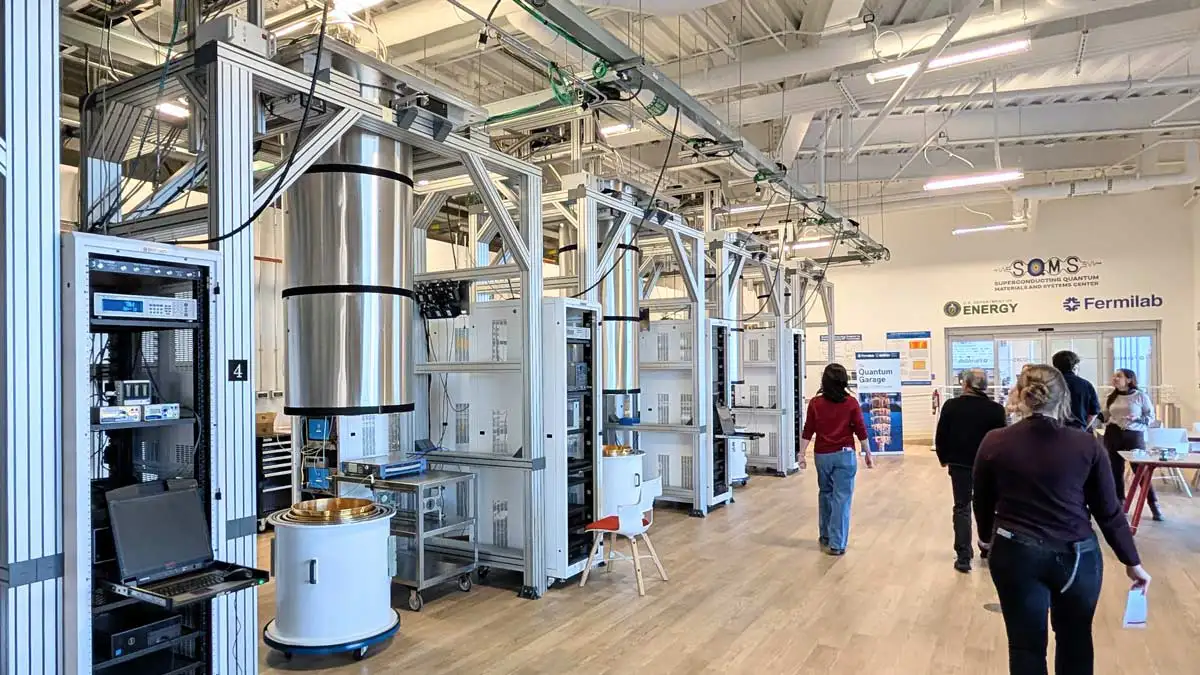
In 2024, the team published an IEEE conference paper on a quantum approach to fixed-point arithmetic for solving ordinary differential equations. In 2025, the researchers built on that advance to propose a quantum method for implementing efficient floating-point arithmetic (the research is undergoing peer review). “We gravitated towards that because it’s the gold standard in classical scientific computing,” said Dr. Cruz Serrallés. He and Dr. Lattanzi recently presented these algorithms at talks at the Fermilab 2025 quantum symposium.
The work has earned recognition in the NIH quantum computing challenge, a competitive call for projects to advance quantum applications in medicine. The NYU Langone and Fermilab team was chosen among 10 finalists—one of only two entries related to MRI—awarded $10,000 and invited to participate in phase two, which runs through late 2027. In this second stage, the teams must demonstrate their algorithms on quantum hardware.
Dr. Cruz Serrallés said that “algorithmically” the next step is clear: develop a quantum search algorithm capable of extracting information from a dictionary. In practice, he said, quantum computing is such a new technology that it’s too early to know how the investigation will develop. The largest quantum computer developers like IBM and Google have published roadmaps to hardware that, if built, promises to extend quantum’s reach beyond the realm of bespoke systems housed in advanced laboratories, but it’s not here yet.
“Once we have the computers, there will be more development, but if you don’t have the tools, you’re going to have to start from zero,” said Dr. Lattanzi. “We’re not going to start from zero,” he said. “We’re going to be ready.”
Related Story
MRI researchers at NYU Langone and colleagues propose a quantum approach to fixed-point arithmetic for ordinary differential equations.